AI & Holy Ghost Stories—A Heads Up
And the part of Joseph's story we got wrong

Hello, friends. I’m happy to let you know that Episode 1 of Holy Ghost Stories Season 8 is LIVE. It’s the first of what will be a 12-part telling of the story of Joseph.
Complicated family dynamics, mysterious dreams, jealousy, betrayal, violence, love, resilience—it’s a grand tour across the quilted landscape of the human condition.
Why watch Netflix when you can listen to HGS?
More on Episode 1 in a moment. But first, a statement.
AI & Holy Ghost Stories
Given the direction of things over the past several months, I’ve been feeling that I’d like to plant a flag publicly regarding HGS and generative AI. There’s a version of what I’m about to say that’s quite lengthy (and perhaps there will be a time for that in the future), but for now let me be as concise as possible:
No AI has ever been or will ever be used in the writing of Holy Ghost Stories.
In a world increasingly filled with AI slop, HGS will remain purely human (and, therefore, thanks to the indwelling of the Spirit, somewhat divine).Research is another question, though I seldom utlilize AI even then. When I do it’s usually for rudimentary questions, and always double checked.
We do not use AI music in the scoring of Holy Ghost Stories.
As most of you well know, there are times we work with a composer to create an original score for an episode or a season. Most of the time, we’re sourcing music from subscription libraries. These libraries are full of beautiful, evocative pieces created by musicians all over the world. To my knowledge, these libraries do not contain AI music. If they begin hosting AI generated pieces, I hope they’ll clearly designate them as such, making them easy to avoid.
Again, maybe I’ll come back to talk more about the whys and wherefores of this position. (I have strong feelings.) For now, I just thought I’d let you know the answer to a question I find myself asking about so much these days: “Did you write this, or did you prompt AI to generate it, change some wording, and convince yourself you wrote it?”
If you find yourself wondering something similar about Holy Ghost Stories (or these emails, for that matter), the answer is always the same: For better or worse, I wrote it.

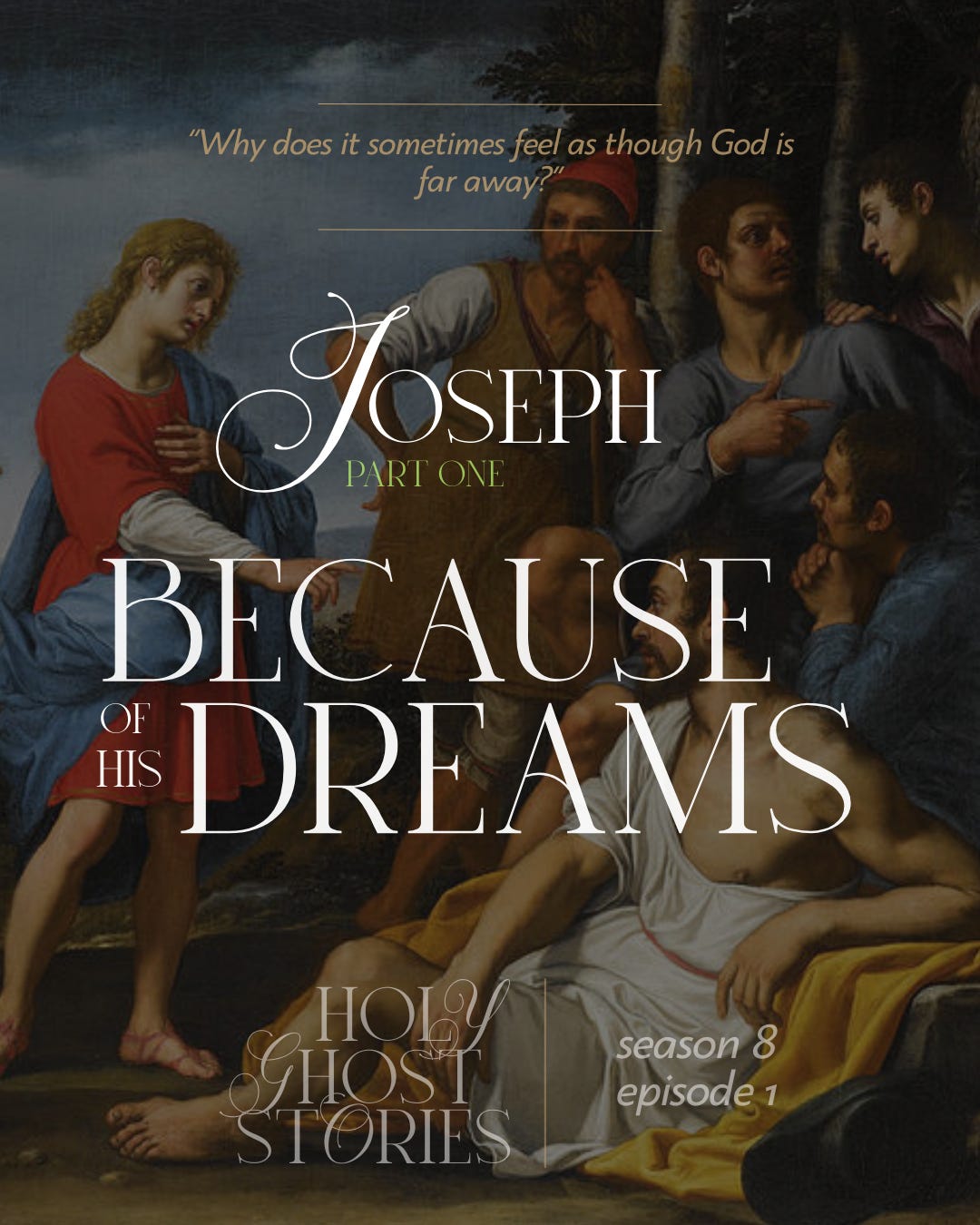
NOTES ON EPISODE 1, “Because of His Dreams”
🚨“Wait, what?” Warning
As in our previous telling of this part of the Joseph story, this episode may diverge from what you’ve heard/thought if this text is familiar to you. Namely, the way we portray the Midianites, rather than Joseph’s brothers, selling him into slavery.
“But Justin,” you say, “the Bible clearly says ‘When Midianite traders passed by, his brothers pulled Joseph out of the pit and sold him for 20 pieces of silver to the Ishmaelites, who took Joseph to Egypt.’”
You’re right—at least some translations say as much (the NASB, for example, does not). But when they do, the translators are taking liberty with a pronoun. The Hebrew text actually says “they pulled Joseph out of the pit…” Alistair Roberts and others have compellingly argued that the most likely antecedent to the “they” is the Midianites, not the brothers. This would square with Reuben’s surprise at Joseph’s absence after the fact, and the brothers’ seeming lack of awareness of the transaction when Reuben reports him missing in verse 30.
This understanding seems to be the prevailing Jewish opinion. It also seems to fit with Joseph’s later statement: “I was indeed stolen out of the land of the Hebrews.”
I could be wrong, of course. But this is what makes the most sense to me, and that’s why I tell the story the way you’ll hear it in this episode.We don’t get a ton of Yahweh in this episode. On one level, that makes me sad. I thought about taking a few more moments to imagine things from His perspective (and this would likely be a great exercise for you in your own meditations), but I decided against it.
Why?
This is a story in which Yahweh’s explicit, detectable presence is limited. He speaks through two dreams and that’s it. No explanation of how the dreams will play out, when that will happen, why the heartbreaking trafficking of Joseph doesn’t mean the dream has been defeated…none of that. I think that’s valuable, because that’s how it often feels our lives are playing out as well. I think that’s part of what the story is about, in fact. How do we respond when God feels absent? When it seems His plan is in jeopardy and He doesn’t say a thing? I wanted to tell the story in a way that honors the questions, confusion, and frustration His silence can provoke in us. (And tell it, too, in a way that honors Yahweh’s unseen work as He faithfully ensures the fulfillment of the dreams He gave to Joseph.)
Ever wondered what it was like for one or two of the guys to go get a goat for the blood-on-the-robe ruse? If they don’t have domesticated goats with them (the passage seems to indicate they only had sheep), they had to go catch a feral one. I had to see what this would have looked like, so I turned to YouTube with high hopes. I was not disappointed.
And now, for your viewing pleasure…
LISTEN
Alright—part one is all yours. I do hope it blesses you. As always, I’d love to hear your impressions—reply to this email, send a pigeon, whatever.

Listen on: APPLE PODCASTS | SPOTIFY | WEB
3 Cool Things
The Octopus Is an Incredible Animal - You knew this, surely, but here’s more evidence:
Virginia Woolf’s Errands are More Interesting than Our Adventures - Case in point, this essay. I’m a big fan.
“A Quiet Life” - Love this poem by Baron Wormser (2008):
What a person desires in life
is a properly boiled egg.
This isn't as easy as it seems.
There must be gas and a stove,
the gas requires pipelines, mastodon drills,
banks that dispense the lozenge of capital.
There must be a pot, the product of mines
and furnaces and factories,
of dim early mornings and night-owl shifts,
of women in kerchiefs and men with
sweat-soaked hair.
Then water, the stuff of clouds and skies
and God knows what causes it to happen.
There seems always too much or too little
of it and more pipelines, meters, pumping
stations, towers, tanks.
And salt — a miracle of the first order,
the ace in any argument for God.
Only God could have imagined from
nothingness the pang of salt.
Political peace too. It should be quiet
when one eats an egg. No political hoodlums
knocking down doors, no lieutenants who are
ticked off at their scheming girlfriends and
take it out on you, no dictators
posing as tribunes.
It should be quiet, so quiet you can hear
the chicken, a creature usually mocked as a type
of fool, a cluck chained to the chore of her body.
Listen, she is there, pecking at a bit of grain
that came from nowhere.
That’s the latest! Let me know how “Because of His Dreams” hits you.
Gratefully,
Justin
Good morning, Justin.
Thank you for sharing your hear and clarifying your position on AI. I believe that Yahweh put creativity within each of us as it is part of worship. When we let others take that from us, we lose a way we can worship. Thank you for the time, energy, and care you give in order to share a way that I can experience a way of worship that is unfamiliar to me.
It is so wonderful to see the different perspective of the Hebrew language that creates a more robust story. What I love is knowing how Yahweh makes all the pieces work together and saves us.
Thank you for sharing the fun animal experiences. Yahweh is amazing!
I love the poem, too. It ads perspective!
And a stunning poem to boot